Monday, January 28, 2013

And the Beet Goes On... at The Garrison School

Chef Laurie Gershgorn from Healthy Culinary Creations kept the Garrison School's 4th graders very busy this week with two beet dishes to prepare in just one hour: A raw beet borscht and beet pasta. Each group had a copy of the recipe and worked independently on their task.

One group worked on the raw beet soup and chopped beets, carrots, leeks and herbs. 


Another group measured all the liquids for the soup. 


While a third group worked on the pasta dish and separated the leaves from the beets...


chopped the fresh herbs and garlic, and cut up the pre-roasted beets.


After everything was prepped and ready, Chef Laurie explained to the 4th graders that it is very important to have Mise-en-place she said (pronounced [miz on plas]). This is a French culinary term which means "everything in place," as in set-up. It is used in professional kitchens to refer to organizing and arranging the ingredients before you begin to cook.
When all the prepping was complete, they all went into the kitchen and started cooking. 


The first dish they completed was the Raw Beet Borscht.

Next came the beet pasta. 
 And the final verdict: The Raw Beet Borscht – a little too garlicky. 

The Beet Pasta – Yum!

The Beet Pasta will be served for all the Garrison students on February 26th.

Sunday, January 27, 2013

“A Garden for Every Child. Every Child in a Garden.”


"A Garden for Every Child. Every Child in a Garden." This is the tagline for the U.S. government's gardening program in World War I. 
Check out this interesting article on the History of School Gardens by Rose Hayden-Smith, an academic with the University of California's Agriculture and Natural Resources Division. 

Thursday, January 24, 2013

It's a Party in my Mouth!


No, I'm not talking about the latest junk food craze. I'm talking about beets! At least that is what one Haldane 4th grader said after trying the beet soup his class made with the chefs from the Culinary Institute of America yesterday. 
 
Beets are the featured vegetable for January at Haldane and The Garrison School's Chef in the Classroom programs.

Last week, chefs Matt Sporer and Sarah Garcia, students and Slow Food members from the Culinary Institute of America visited Haldane's 4th and 5th graders to make a creamy beet soup with homemade croutons. 

Students donned plastic gloves before peeling and grating the dark red beets purchased from a local farmers' market. 


Others chopped onions and garlic and tore fresh sage and thyme into small pieces. 


Everyone got a chance to mix the ingredients in the saucepan. 

To finish the soup, Matt added local Hudson Valley Fresh cream and used a hand blender to puree until smooth.


While the soup was cooking, students took turns grating gruyere cheese and Chef Matt cut up a freshly baked baguette from the Apple Pie Bakery at the CIA into small slices. 


Next, the the baguette slices went in a pan and students drizzled olive oil and grated gruyere on the toasting bread.


And when it was time to try their creation, what was the response?

It's a party in my mouth!

I want to make it every day!

I'm in heaven it's so good!

These are 4th and 5th graders talking about beets!
Parents, you can't beet that!

Wednesday, December 5, 2012

November was Pumpkin Month!

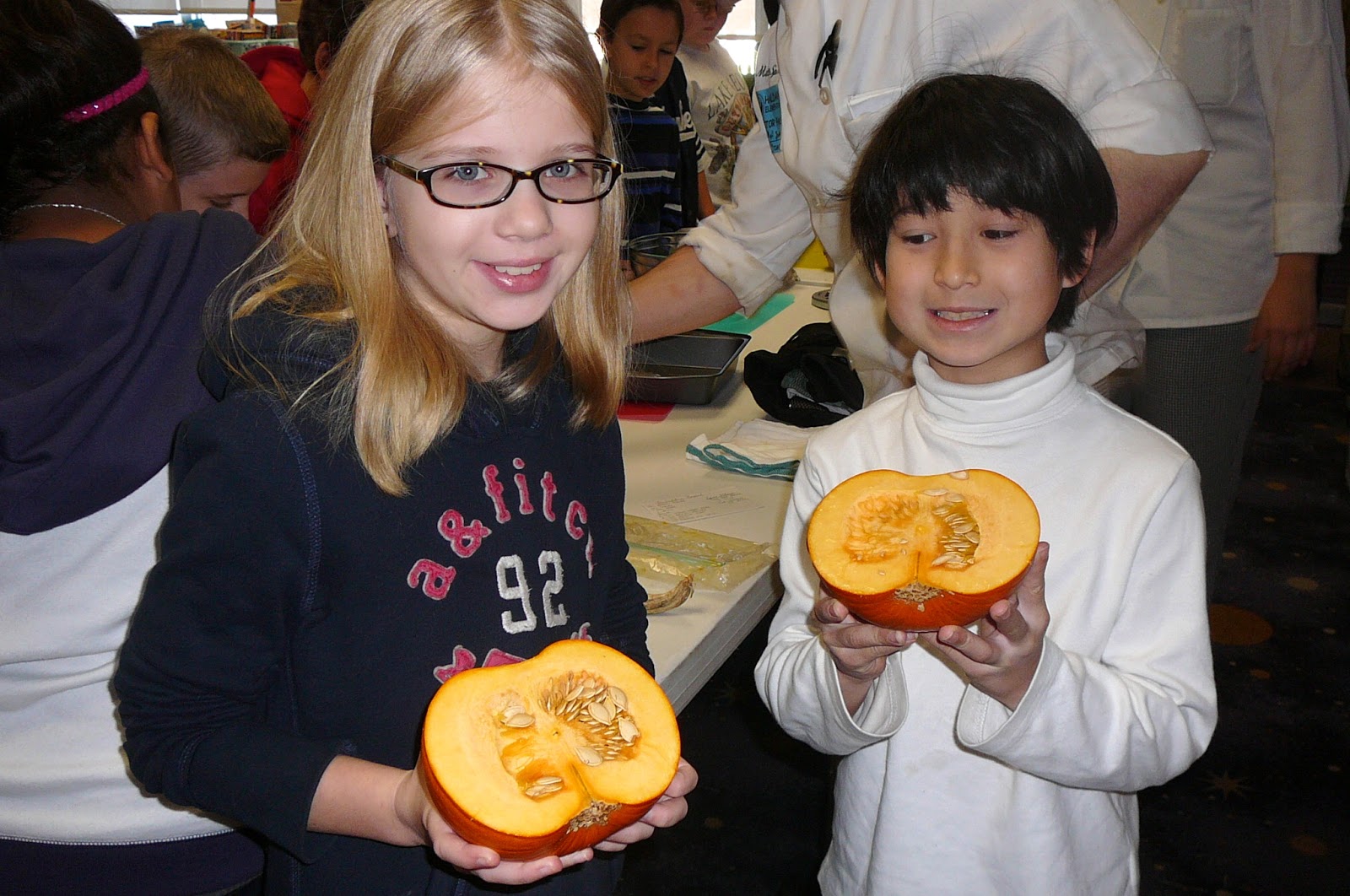
The featured vegetable for the month of November was Pumpkin. Through our sponsor, The Hudson Highlands Land Trust, HVFS received 50 pumpkins donated from a family farm in Garrison, NY. Our chefs at Haldane and the Garrison School used these pumpkins in our Chef in the Classroom program teaching kids how to cook with local, seasonal produce.

At Haldane, Chefs Sarah Garcia and Matt Sporer, students from the Culinary Institute of America and Slow Food members worked with the 3rd and 4th graders teaching them how to make pumpkin bread.

From mashing to mixing, the kids did all the work.


Chef Sarah is a pastry chef in training and explained to the students the importance of accurate measurements of all the ingredients. Instead of using cups and teaspoons, in a professional bakery, they use a digital scale to measure in grams and ounces. (This was a great lesson in math and chemistry!)


At the Garrison School, Chef Laurie taught the 7th graders how to make pumpkin muffins. She  divided the students into groups and handed them recipes with step by step instructions.


The groups worked independently with only guidance and tips from the chef.


Both the Haldane School and the Garrison School students will get to sample these recipes in the cafeteria this month.


Many thanks to the family farm in Garrison for donating the pumpkins used in the cooking classes and in the school-wide taste tests in the cafeterias.

Wednesday, November 14, 2012

Kids will eat more apples if they are offered in bite-sized pieces.

There are various tactics one can use to persuade a child to eat a fruit or vegetable. For example, the convenience of fruits and vegetables has led to greater consumption of these items. Children are more likely to eat fruits and vegetables when they are offered in bite-sized pieces.

A study conducted by Cornell University, with the assistance of Wayne County Cornell Cooperative Extension and six middle schools in Wayne County, New York, showed an increase of 32% in the number of all students who took apples when they were sliced.  Further analysis showed that children who took apples wasted 30% less when the apples were sliced.  The school districts that were part of the research project were Gananda, North Rose-Wolcott, Red Creek, Sodus, Wayne and Williamson.

The USDA’s work with stakeholders combined with behavioral economists’ research to develop innovative ways to encourage students to make healthier choices offers a new strategy for change. The Cornell Food and Brand Lab has already started working on a “Smarter Lunchroom Initiative” under Dr. Brian Wansink to encourage healthier eating in the lunchroom. The lab has made a new tray design with special compartments to fit milk instead of soda, and smaller portions of sides to avoid easy placement of foods like pizza or French fries. The researchers have also encouraged elementary school cafeteria workers to use an apple slicer rather than providing whole apples to students because studies have shown that kids are more likely to eat “apple fries” rather than whole apples. Making children feel like savvy consumers rather than obedient children is a simple strategy to help them make better decisions.